Orcho for Technical Leaders
This page is for technical leaders evaluating Orcho as an operating assistant for AI-assisted delivery.
Do not evaluate Orcho as “another coding agent.” The useful question is whether it gives your team a production harness and control plane for agentic software delivery: accountable runs, review loops, evidence, policy, recovery, and economics.
Technical leadership view
Orcho helps leaders inspect and shape agent work without turning delivery into a loose chat transcript. The system is valuable when it can answer: what happened, why it was trusted or rejected, what it cost, and what the next safe action is.
What to evaluate
Section titled “What to evaluate”Evaluate Orcho by the controls it adds around AI work.
| Leadership concern | Orcho mechanism | What to inspect |
|---|---|---|
| Agents say “done” too early. | Review, repair, and final acceptance gates. | False-ready delivery |
| Work disappears into chat history. | Durable run artifacts and evidence bundle. | Evidence bundle |
| Every task gets the same process. | Profiles choose workflow depth by work kind. | Profile semantics |
| Recovery is ad hoc. | Resume, phase handoff, and correction follow-ups. | Recovery and resume |
| Cost is invisible. | Token, phase, runtime, and API-equivalent accounting. | Cost accounting |
| Leaders cannot operate the system from an assistant. | MCP typed lifecycle control. | LLM captain mode |
| Project context is tribal knowledge. | Project tuning, plugins, and prompt composition. | Project tuning and plugins |
| Security review needs data-flow clarity. | Local artifacts plus explicit worker-runtime boundary. | Security and privacy |
Those concerns, answered by one real run — the closing rollup of an actual feature run (a plan rejected on review, re-planned, then shipped), rendered from its own artifacts:
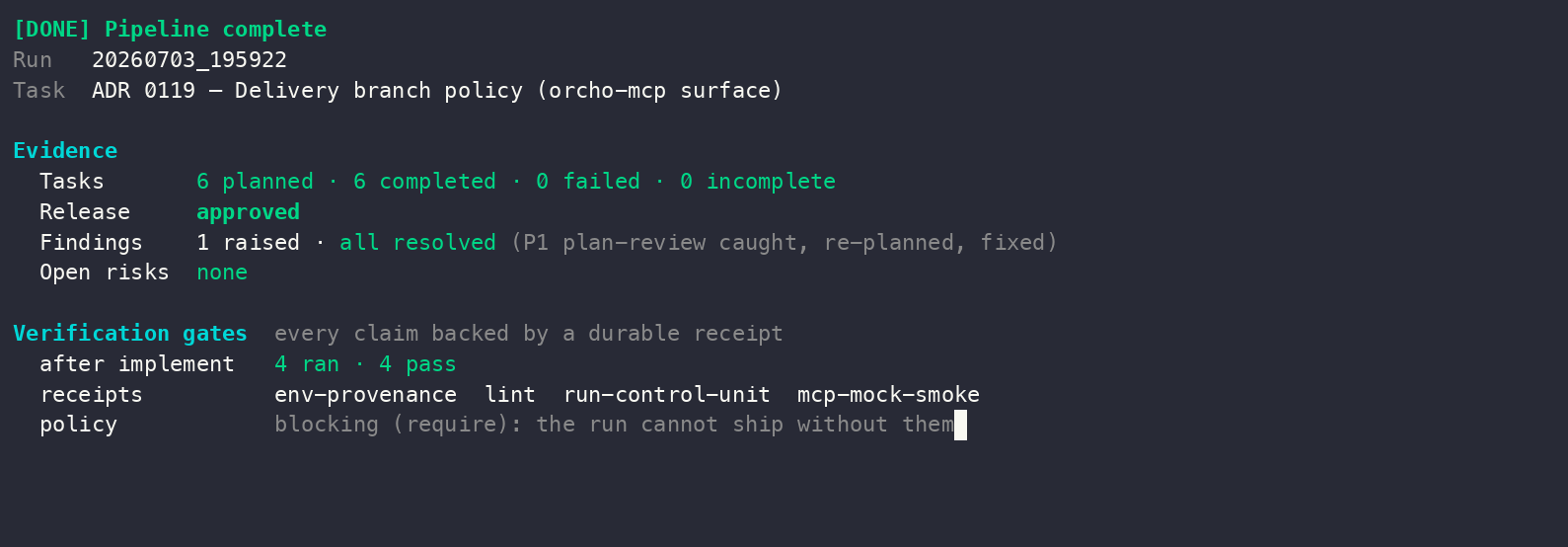
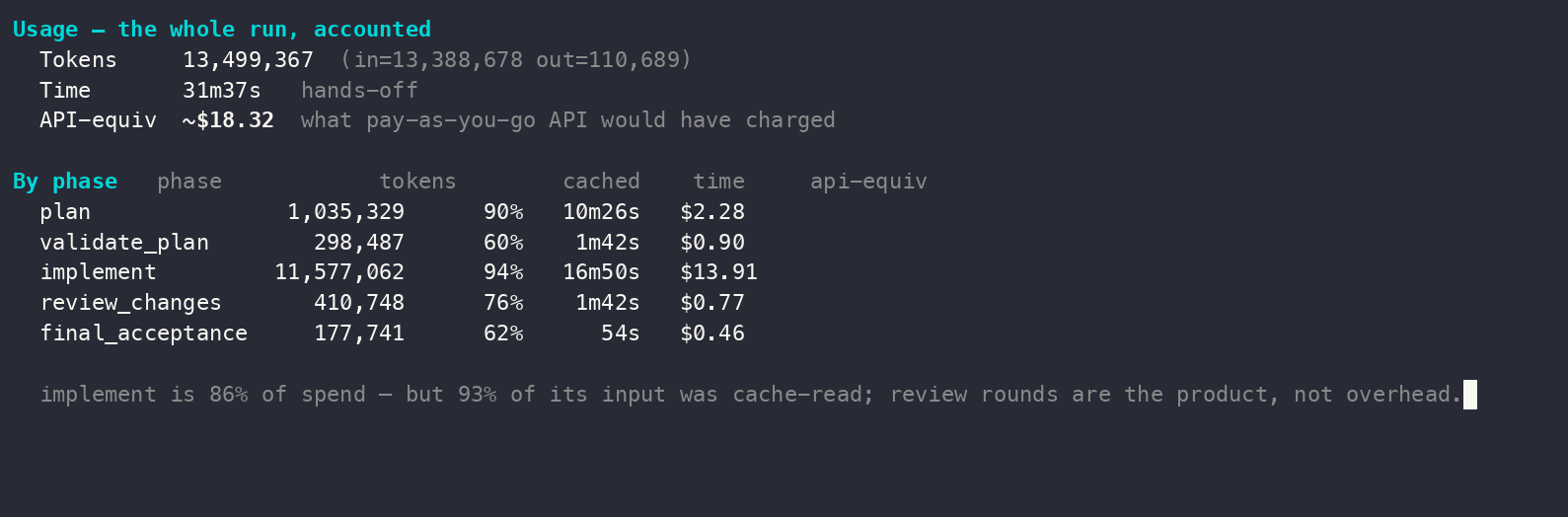
Every claim is backed by a durable receipt, every token and dollar is attributed by phase, and the whole thing is plain local JSON you own — the “done too early”, “cost invisible”, and “work disappears into chat” rows above, made inspectable. See it move on Watch the run; the full breakdown is in Cost accounting.
Cognitive offload proof
Section titled “Cognitive offload proof”Orcho does not argue with your existing worker workflow. If your team already uses Claude Code, Codex, Gemini, or another agent CLI, Orcho can invoke that runtime as a phase worker.
The value is a different plane: standardization, repeatability, protocol, and inspectable control.
The proof is what no longer has to live only in the operator’s head:
| Cognitive load before Orcho | Orcho surface |
|---|---|
| Which task did I actually ask the agent to solve? | persisted task, profile, and run metadata |
| Did the agent plan before editing? | plan phase and parsed plan artifacts |
| What code was changed and why? | diff artifact, phase summaries, evidence bundle |
| Did review reject anything? | typed findings with severity and required fixes |
| Did a repair happen or did we accept risk? | repair phase, waiver/decision records, final acceptance |
| Which verification ran? | receipts, commands, gate results |
| Is this run paused, failed, halted, or ready? | status, halt reason, next action |
| Should we resume or start a correction follow-up? | checkpoint state, follow-up lineage, delivery decision |
| Where did the tokens go? | metrics by run, phase, runtime, cache, and window |
That is the concrete cognitive unload: Orcho turns control memory into artifacts. A second engineer, a team lead, or an LLM client can inspect the run without replaying the original chat.
A practical test:
Can someone who did not watch the agent session answer what happened,why the result was accepted or rejected, what verification exists,what it cost, and what the next safe action is?If yes, Orcho is doing useful delivery-control work. If no, the run is still too close to a private agent transcript.
The technical assistant angle
Section titled “The technical assistant angle”The leadership value is not that Orcho writes code. Worker runtimes already do that.
The value is that Orcho can become a technical assistant for delivery control:
- “Show me why this run was rejected.”
- “Which phase consumed the most tokens?”
- “Which verification receipt is missing?”
- “Is this a checkpoint resume or a correction follow-up?”
- “Which profile did we use and why?”
- “What evidence exists before we call this ready?”
- “Did MCP add useful lifecycle control, or just extra overhead?”
That is a different product shape from a chat agent. The assistant is useful because it reads typed state, evidence, metrics, and decisions rather than asking humans to reconstruct them from terminal logs.
Durable technical advantages
Section titled “Durable technical advantages”If you are looking for moat, inspect mechanisms rather than claims.
The defensible part is the way these pieces reinforce each other:
- Profile plane: work kind maps to workflow shape, gates, and recovery.
- Phase protocol: planning, implementation, review, repair, and final acceptance are separate surfaces.
- Evidence model: runs leave artifacts that can be inspected after the agent session is gone.
- Policy layer: gates and profiles encode delivery rules instead of relying on prompt discipline alone.
- Prompt engine: project context, role, task, format, and protected contracts become composable engineering artifacts.
- MCP control: an LLM-aware client can operate the lifecycle through typed tools instead of prose scraping.
- Accounting: token, cache, phase, runtime, and API-equivalent economics make workflow depth measurable.
- Workspace boundaries: run state, project code, artifacts, and follow-up lineage stay separable.
- Cross-boundary direction: participant-set and cross-project work can be treated as an extension of the same delivery protocol, not a separate trick.
None of these is enough alone. Together they make Orcho harder to copy than a simple “run many agents” wrapper.
What this helps a CTO decide
Section titled “What this helps a CTO decide”Use Orcho to answer operating questions:
| Decision | Evidence to use |
|---|---|
| Should we use a lighter profile for this class of work? | Phase cost, rejection rate, final acceptance findings. |
| Are agents improving delivery or adding review load? | Review/repair/final acceptance outcomes over a run window. |
| Which project needs better tuning? | Repeated findings, missing receipts, runtime failures, high repair cost. |
| Is a subscription-style provider plan carrying real workload? | API-equivalent cost versus actual monthly usage pattern. |
| Is MCP worth the overhead? | Fewer blind retries, clearer handoffs, better resume/correction decisions. |
| Where do we need stronger policy? | Gates repeatedly waived, missing verification receipts, false-ready patterns. |
What this does not replace
Section titled “What this does not replace”Orcho is not a substitute for engineering judgement.
It does not replace:
- code ownership;
- architecture review;
- product priority decisions;
- security review for sensitive changes;
- real project verification;
- provider billing and contract review.
It also does not yet provide an organization-level control plane. Orcho’s policy and gates are local per-project, per-run contracts — not central RBAC, tenant-wide audit, or team budget enforcement. Read the “policy layer” above as delivery control for the runs on a machine, not as an org governance suite. Project status states the stage, license, and scope boundary in one place; Security and privacy traces the data-flow boundary. An interim pattern while the boundary holds: run directories are plain files, so ship them into your own storage or SIEM on your schedule.
It gives leaders a better operating surface for the AI delivery work that is already happening.